Lipce villagers
The PeasantsThe Lipce villagers function as a collective character whose power depends on gathering, shared grievance, and the authority of local leaders. They can mobilize nearly the whole community against the manor’s felling of the forest, resist the demands of officials, and close ranks against gendarmes; they can also turn that collective force on Jagusia. The contrast makes the village’s solidarity consequential but not inherently just: the same capacity to act together can defend common interests or enforce a violent moral judgment.
A Community Gathered Around Its Leaders
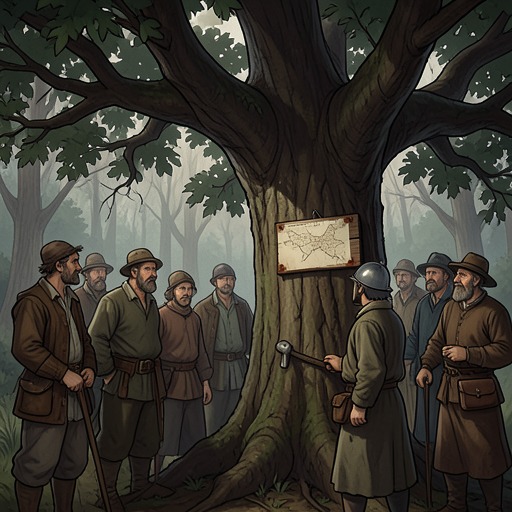
When the villagers assemble in the square before the inn to confront the threat to the forest, they wait for the elders, who have gone to fetch Maciej Boryna. The crowd keeps growing until it fills the square and reaches the road, yet the gathering is initially marked by restraint: people greet one another quietly, find places to stand, and wait. Their patience reflects the accepted standing of Maciej Boryna as the village’s first farmer and the person expected to lead; no farmer, the narration explains, would take a step without him.
The scene depicts the crowd as a body still forming its purpose. Small signs of agitation—a word, a raised fist, a flushed face—surface and then subside. The villagers are compared to trees packed together and to sheaves of hay propped side by side: images that give their multitude weight and density, while suggesting that individual voices remain part of a larger whole. Their unity is not automatic, however. It takes leadership and a shared account of injury to turn a packed crowd into concerted action.
Resistance to the Manor
The immediate grievance is the manor’s felling of the villagers’ forest, intensified by the refusal to employ them for the work. A speaker appeals to farmers and hired hands alike, presenting the logging as the latest in a succession of injuries, confiscations, and unanswered complaints. The villagers have taken grievances to court and voiced them without effect; the forest’s destruction becomes the point at which patience gives way to direct resistance.
The blacksmith and the miller attempt to deter the crowd, warning that the village could end up in chains and jail. Their intervention fails because villagers regard both men as serving the manor’s interests. Against that warning, the speaker frames resistance as a defense of the community’s rights and justice, urges everyone able to move to go together, and insists that the authorities cannot punish an entire village. The crowd answers with a common cry and breaks into hurried preparations.
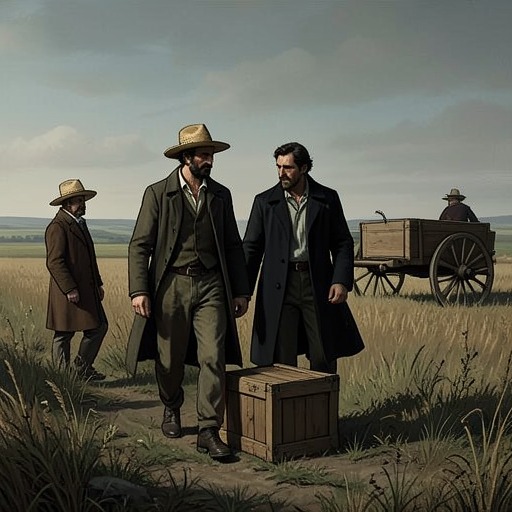
The preparations give the decision a visible, practical form. People change clothes, harness horses, and drag out sleighs; children shout while women lament. Within a short time the villagers are armed and assembled on the poplar road, where Maciej Boryna is waiting with Płoszka, Kłąb, and other leaders. Peasants, farmhands, women, and some older children join the line. Some travel by sleigh, horse, or cart, while almost the whole village sets out on foot. Poles, rusty pitchforks, flails, and occasional scythes rise above the crowd. The people move without the laughter or jokes associated with an ordinary journey to the fields; Maciej Boryna crosses himself, gives the signal to go, and the procession sets off.
Defiance in Public Life
The villagers’ collective action also appears in encounters with officials. During a debate about the proposed school, most of those gathered in the square lean toward voting against it. When the notary calls for someone to go to the manor and fetch fish, no one moves. His imperious request meets a refusal from the crowd: they have come to discuss the matter, not to run errands. The moment is brief, but it shows the community withholding the routine cooperation that an official assumes it can command.
In a later confrontation involving gendarmes, the villagers close around the officers when the Village Head of Lipce calls to them. Someone warns against laying a finger on anyone and invokes the number of people present. The crowd then parts to let the gendarmes through, but surges after them toward the prefect, angry and cursing, with fists shaking. A voice objects that the villagers are ordered to listen, pay, and abase themselves, while being made to use another’s language. The gathering thus combines physical pressure with an explicit complaint about unequal authority and imposed language. Its members do not simply block passage: they let the officers through and then follow as a body, keeping their anger publicly visible.
After gendarmes search several cottages for a man they have failed to find, the village breathes again. People immediately recount what happened at the Kłąbs’, Grzela’s, and Mateusz’s houses, each claiming the best view and the least fear, or boasting of having provoked the officers most. The episode shows how a threatening encounter becomes shared village talk, retold through competing claims about who stood firm. Collective relief does not erase the pressure of the search; it converts the event into a communal account of resistance.
Judgment and Expulsion
The same collective energy takes a radically different direction when hostility toward Jagusia erupts. Past resentments, envy, anger, and hatred are voiced together, with each person adding grievances until the noise becomes a clamor of overlapping accusations. The crowd’s condemnation connects Jagusia to several alleged wrongs, including her conduct toward Jasio and the death of Maciej Boryna. In this gathering, accusation accumulates rather than being tested: one grievance amplifies another, and the mounting chorus makes a case for expulsion feel like a communal verdict.
The villagers call for Jagusia to be driven out and banished to the woods. Led by the wives of the organist and the Village Head of Lipce, they first go to the Village Head’s home, where they encounter his wife in tears. They comfort her before Jagusia becomes the subject of their attention; once they blame Jagusia for her misfortune, the woman collapses into sobbing. Sympathy for one distressed villager and hostility toward another therefore coexist within the same movement of the crowd.
The violence escalates into an assault on Dominikowa’s household. A furious multitude, led again by the wives of the organist and the Village Head, floods into the cottage. Dominikowa bars the way and is trampled; Jędrzych leaps to defend her and is beaten down as well. Mateusz tries to stop the intruders at the storeroom with a bar, but they split his head and leave him unconscious. Jagusia, shut inside, does not resist when the door is torn down. The villagers drag her from the room and throw her, tied like a sheep, onto a cart loaded with pigs’ dung, then set off amid insults, laughter, and curses. They stop in front of the church, where a further call for humiliation is shouted.
Collective Power and Its Cost
The villagers’ actions are not reducible to either communal virtue or mob cruelty. In the forest conflict, collective organization gives farmers, laborers, women, and older children a means to oppose the manor after complaints and legal recourse have failed. In encounters with officials, a crowd can refuse service, protect its members, and make resentment over language and unequal obligations audible. These episodes show practical forms of local political power, dependent on numbers, common claims, and the presence of leaders.
The expulsion of Jagusia exposes the danger within that power. A community capable of defending shared rights also claims authority to decide who belongs and to enforce its verdict through physical violence. The repeated movement from gathering to chorus, from chorus to action, is central to the villagers’ characterization: unity enables resistance, but it can also drown out individual defense and turn accumulated grievance into punishment. Their collective role therefore carries both the force of mutual action and the cost of making a community’s anger appear to speak for justice.